Deeper Life Enterprise Solutions — Church Management Suite
From member records to House Caring Fellowships and service attendance, the Deeper Life Enterprise Solutions brings the moving parts of church administration into one connected system, so leaders can spend less time on paperwork and more time caring for people.
Role
Duration
Tools
Team

Deeper Christian Life Ministry is a global church with congregations across many countries, each running Sunday services, midweek meetings, small Sunday-evening gatherings held in homes and other locations to build closer bonds between members. Keeping track of who belongs where, which fellowship meets where, and who attended which service had become a large data challenge spread across many hands.
As Product Designer, I designed three connected web dashboards to bring this together: a Membership Portal for managing member records, an HCF Portal for organising fellowships and their members across locations, and an Attendance Portal for recording and reviewing attendance at any service. The core challenge was making large volumes of member and attendance data feel simple for church workers and volunteers, many of whom are not everyday software users.
With congregations, services and House Caring Fellowships running across many locations, the church needed an accurate picture of its people, but member, fellowship and attendance records were scattered across paper registers, spreadsheets and individual workers. Leaders couldn't easily answer simple questions: how many members do we have, which fellowship does each person belong to, and who has stopped attending?
Scattered member records. Details lived in different places and formats, so records were often duplicated, outdated or incomplete.
Hard-to-track fellowships. HCFs meet in many homes and locations, making it difficult to know which fellowships exist, who leads them and who belongs to each.
Manual attendance. Attendance was counted and recorded by hand, which was slow, error-prone and rarely reviewed after the service.
No connection between data. Membership, fellowship and attendance records didn't link, so leaders couldn't see the full picture of a member's involvement.
Missed follow-up. Without reliable attendance history, members who quietly stopped coming could go unnoticed for weeks.
Discovery was driven by the brief from DeeperLife Enterprise Solutions. Rather than jumping into screens, I broke the brief down into the church's three core records (members, fellowships and attendance) and mapped how they relate: who creates each record, who updates it, and who needs to see it. That showed where the real complexity sat. It wasn't in any single portal, but in keeping the three connected.
3
Portals Scoped
3
Core Records Mapped
1
Shared Member Record
Key Insights
One member, one record. The same person appears in membership, fellowship and attendance data, so all three portals needed to draw on a single member record rather than keeping separate copies.
Fellowships need structure across locations. HCFs meet in many homes and venues, so each one needed a clear location, leader and member list that leadership could oversee from one place.
Attendance only matters if it's used. Recording attendance was the easy part; the value lay in turning it into trends and follow-up lists.
Leaders need answers, not lists. Dashboards had to surface growth, attendance patterns and members needing attention at a glance.
Simplicity over features. The portals would be used by church workers with mixed digital skills, so every task needed to be obvious on first use.

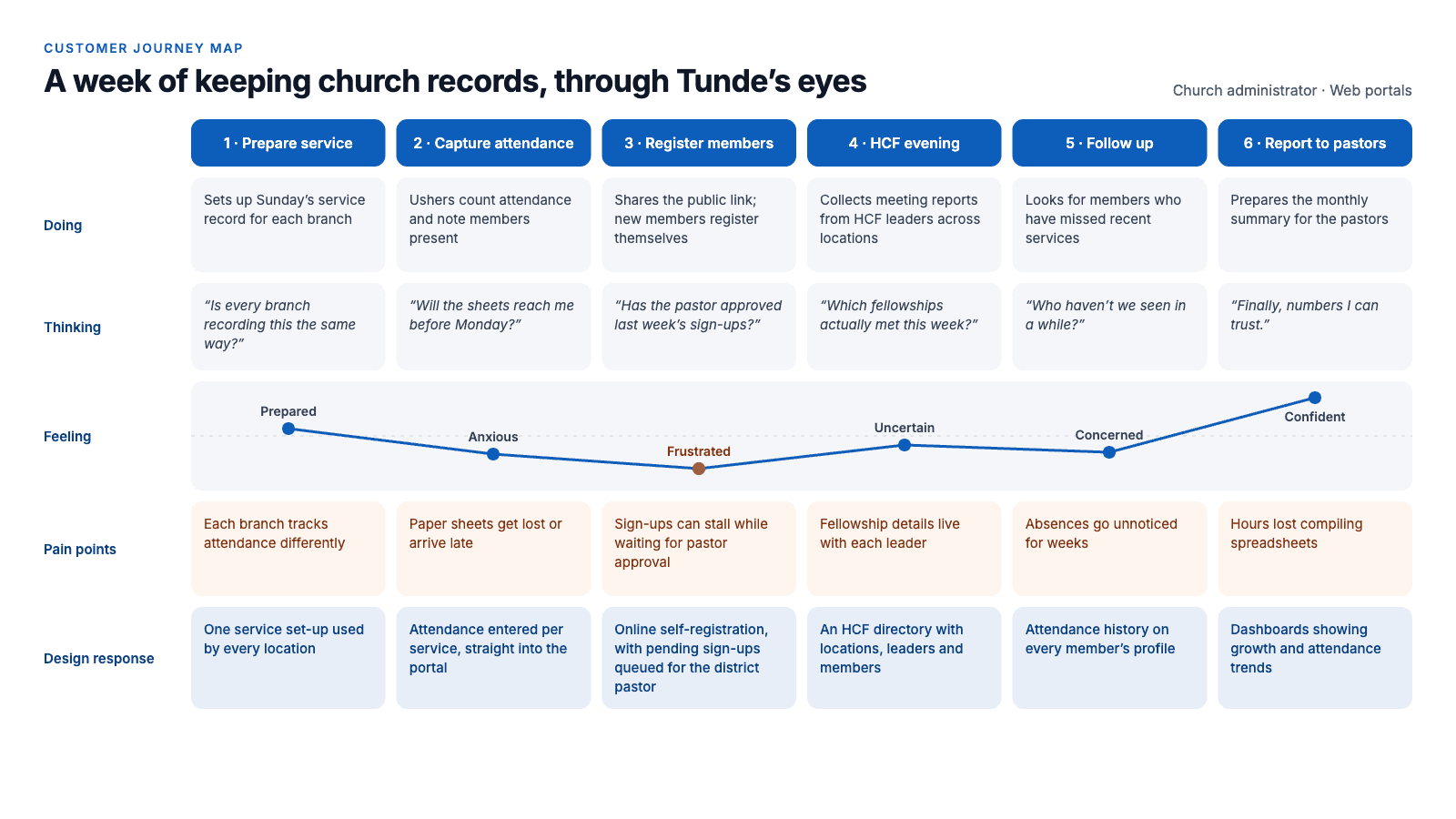
Working from the brief alongside the DeeperLife Enterprise Solutions team, I started ideation by asking a simple question: what does a church leader need to know about a member, and where does that information come from? Mapping the answers showed that membership, fellowship and attendance weren't three separate problems but three views of the same people. From there, I sketched the structure each portal needed and explored layouts for the core tasks: adding and updating members, setting up and staffing HCFs across locations, and recording attendance for any service.
We converged on a concept I called "One Member, Many Gatherings": three focused portals built around a single, shared member record. A member is created once and appears everywhere they belong, in their HCF, in every service they attend, and in the reports leaders rely on. Each portal stays simple and task-focused for the people who use it, while leadership gets a connected view of the whole church.

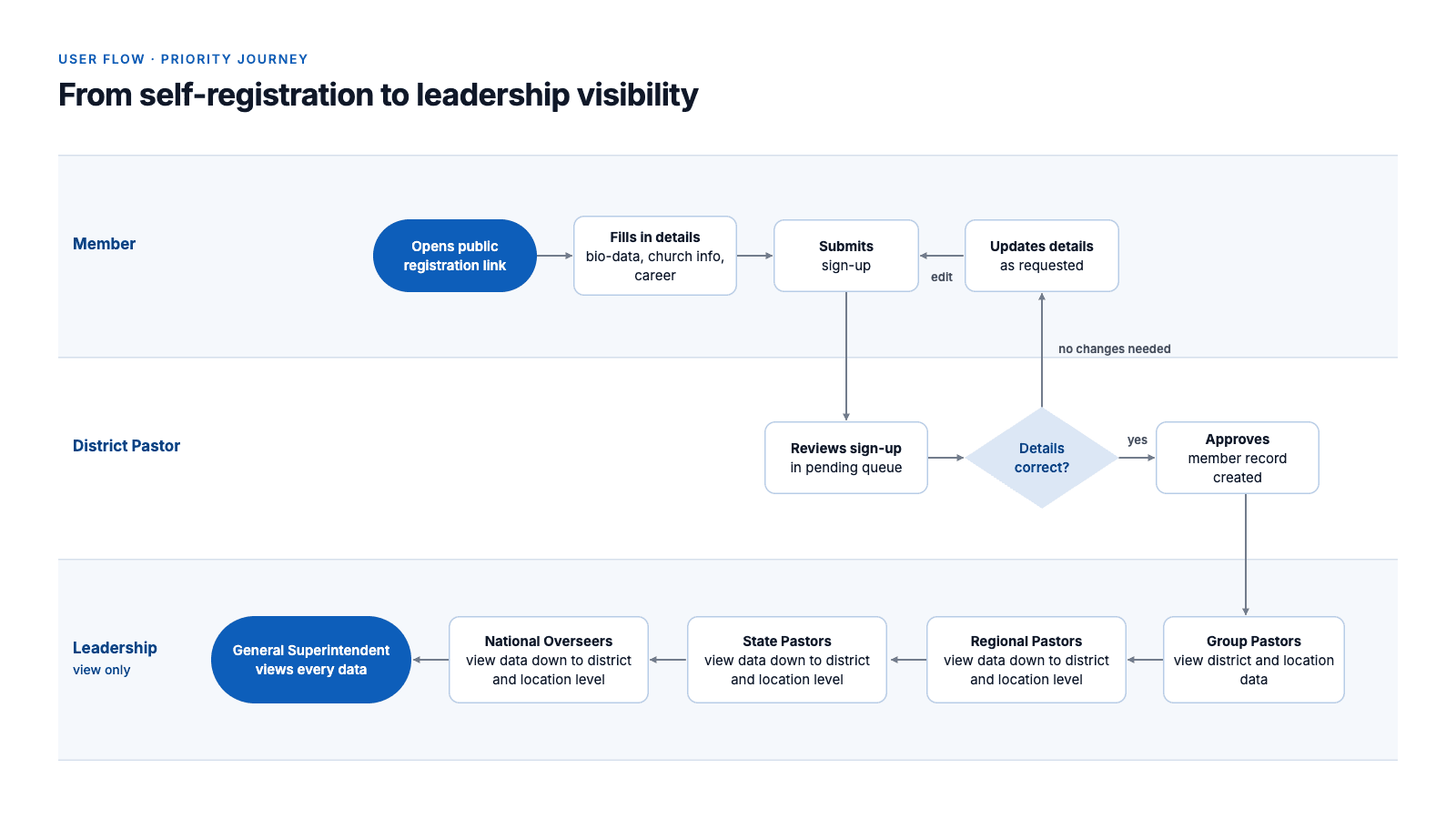
I mapped four primary journeys across the three portals: member self-registration, managing a fellowship, recording attendance, and following up. The priority flow was recording attendance, because it happens every week, involves the most people, and was where records most often went missing. The goal of restructuring was to make every journey start from the same member record, so information is entered once and shows up everywhere it's needed, with no re-typing and no duplicates.
Self-registration to approved profile. Members register themselves through a public link, filling in their bio-data, church info and career details. Their district pastor then reviews the submission and approves it, creating one verified profile shared by all three portals.
Fellowship set-up to membership. An HCF is created with its location and leader, and approved members are added from the shared member list, so each person's fellowship shows on their profile.
Service to attendance record. For each week, attendance is marked per service (MBS, TRETS, SWS and HCF) on the member's attendance report, with past weeks editable and future weeks locked.
Attendance to follow-up. Member statuses (active, inactive, transferred) and attendance history make it easy to spot who has stopped coming, so leaders can reach out sooner.
The structure agreed at mid-fi carried through to a live system that now holds more than 13,000 member records.
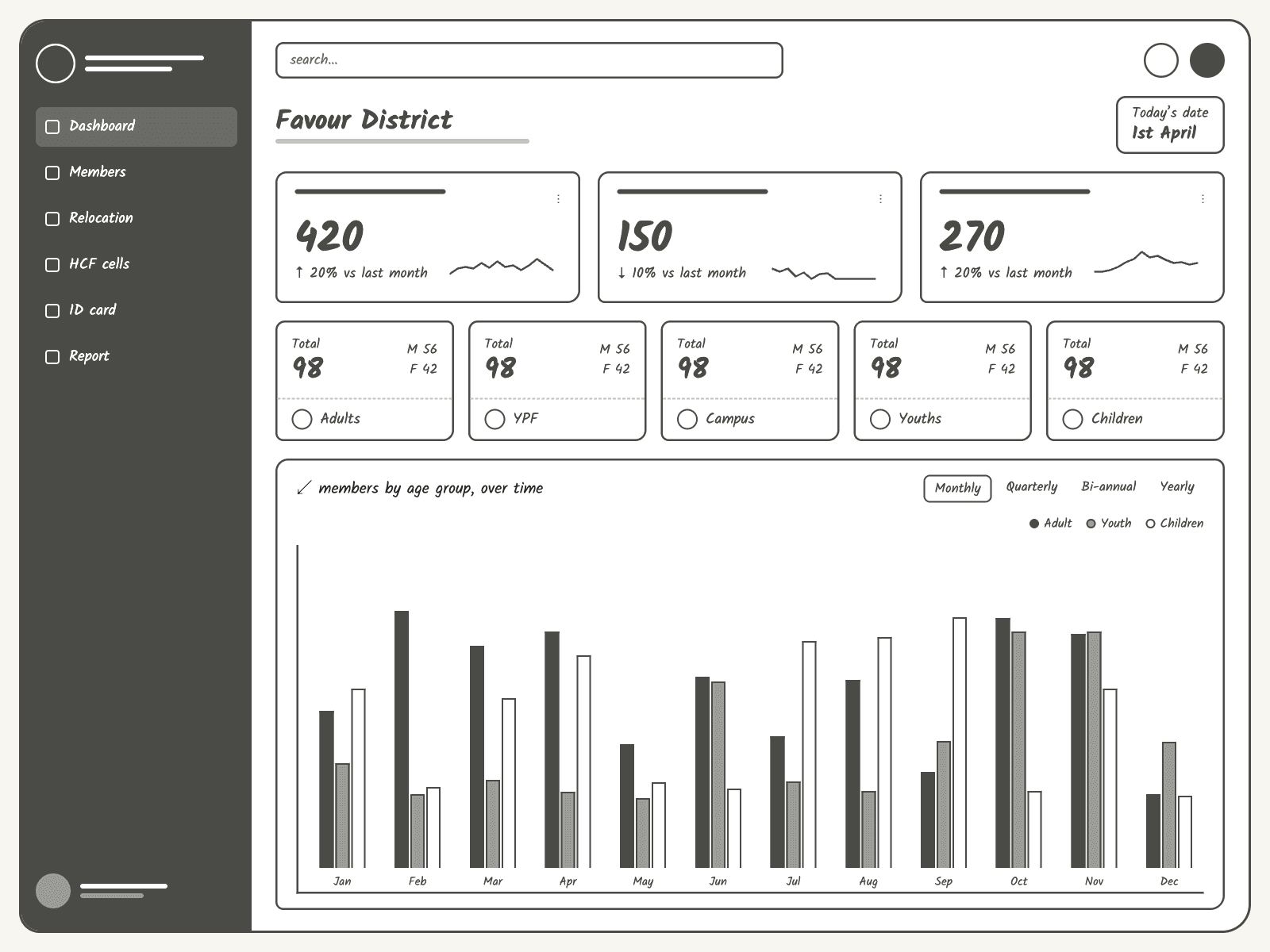
I designed mid-fidelity layouts for the key screens across all three portals, from self-registration and pastor approval to member profiles, the district dashboard and the attendance grid. Working in mid-fi let the team agree on structure and role-based access, meaning what each leadership level sees, before visual design began.
The visual direction needed to feel calm, dependable and respectful of the church's identity, while staying clear enough for pastors at every level to read dense member data at a glance. I anchored the portals in a deep navy sidebar that carries the ministry's name and keeps navigation steady, set against a bright white workspace where the information takes centre stage. A single blue marks links, active states and primary actions, so the next step is always easy to spot. Colour is otherwise reserved for meaning: status pills distinguish active, transferred, inactive and deceased members, and simple green ticks and red crosses make an attendance record readable in seconds. Typography uses Inter for its clarity at small sizes, with generous spacing that keeps long member tables and detailed profiles easy to scan.


I built high-fidelity interactive prototypes in Figma for the core journeys across all key user journeys: member self-registration and pastor approval, managing HCF members, viewing member profiles, and recording weekly attendance. The prototypes were reviewed with the DeeperLife Enterprise Solutions team and church stakeholders, walking through each flow end to end to check that every leadership level, from District Pastor to General Superintendent, saw exactly the information their role allowed, and that pastors with mixed digital skills could complete key tasks without guidance.
For the first time, I can see my whole district's members and attendance in one place.
Iteration 1: Members register themselves. Having church workers type in every new member's details created a bottleneck and room for errors. I moved registration to a public link, so members enter their own details, and their District Pastor reviews and approves each sign-up. Result: data is entered once by the person who knows it best, and every approved member is verified by their own pastor.
Iteration 2: Access that matches the church's structure. Showing everyone the same data would overwhelm senior leaders and expose details to the wrong people. I designed view access around the leadership hierarchy, from District Pastor up to General Superintendent, with each level seeing its own slice of the church. Result: every leader sees exactly what their role needs, no more and no less.

The final design, built around "One Member, Many Gatherings," gives Deeper Christian Life Ministry one connected system for its people. Members register once, their District Pastor verifies them, and every level of leadership sees an accurate, up-to-date picture of the church. Key features include:
Self-registration with pastoral approval. Members sign up through a public link, and their District Pastor reviews and approves each submission before it becomes a record.
A district dashboard at a glance. Total members, male and female counts with month-on-month trends, and a breakdown across Adults, YPF, Campus, Youths and Children.
Growth over time. A chart of members by age group that switches between monthly, quarterly, bi-annual and yearly views.
Member profiles grouped the way churches think. Bio-data, church info and career details, including each member's section and designation.
Clear member statuses. Active, transferred, inactive and deceased members are marked at a glance, with relocation handled in its own section.


50,000+ members registered
3 portals live: Membership, HCF and Attendance
6 leadership levels with role-based access
The portals are live and adoption is growing gradually. As more districts come on board, success will be tracked through how quickly new sign-ups are approved, how many districts record attendance every week, and how early leaders spot members who have stopped attending.
Let people own their own data. Self-registration cut errors at the source and turned pastors into reviewers, not typists.
Hierarchy is information architecture. Mapping access to the leadership structure made the system feel natural to every level.
Design for the least confident user. Simple, familiar layouts mattered more than extra features for pastors with mixed digital skills.
Launch is the start, not the finish. With 13,000+ members registered and adoption still growing, onboarding support is as important as the interface.
Earlier testing would have helped. Putting mid-fi screens in front of pastors sooner would have given us evidence, not just agreement.
Approval reminders so pending sign-ups don't stall.
Absence alerts that flag members who have missed several services.
Onboarding guides to speed up adoption in new districts.

